

Exchange-traded funds (ETFs) have become indispensable tools for traders and investors seeking flexibility, transparency, and cost efficiency. However, during periods of heightened volatility or market dislocation, ETFs can behave in ways that reveal profitable inefficiencies. These moments often open the door to arbitrage opportunities—when an ETF’s price diverges from the value of its underlying assets.
For the skilled ETF trader, understanding and capitalising on these short-lived imbalances can yield significant gains. Yet, exploiting ETF arbitrage during market stress requires a deep understanding of market structure, liquidity dynamics, and execution precision. This article explores how ETF arbitrage works, why dislocations occur, and how advanced traders can navigate them strategically.
How Market Dislocations Create Arbitrage Opportunities
Market dislocations occur when normal pricing relationships and liquidity dynamics break down. In the ETF ecosystem, this can happen for several reasons:
- Underlying Market Illiquidity: When the securities held by an ETF become difficult to price or trade, the ETF may continue trading while its underlying value becomes uncertain. This often happens in bond or emerging market ETFs during periods of market turmoil.
- High Volatility and Rapid Flows: During large sell-offs or rallies, investors may rush into or out of ETFs faster than the underlying markets can adjust. This imbalance can cause significant price divergences.
- Disruptions in Market-Making Activity: If authorised participants or liquidity providers temporarily withdraw due to extreme volatility, the arbitrage mechanism weakens, allowing discounts or premiums to widen.
Such conditions can appear chaotic, but they also present calculated opportunities. Traders with the right analytical tools and risk controls can identify temporary inefficiencies that revert quickly once markets stabilise.
Spotting ETF Arbitrage Opportunities
The first step for any trader seeking to exploit ETF arbitrage opportunities is detection. Successful identification requires a blend of quantitative analysis, real-time data monitoring, and contextual market awareness.
Here are key indicators and tools professionals use:
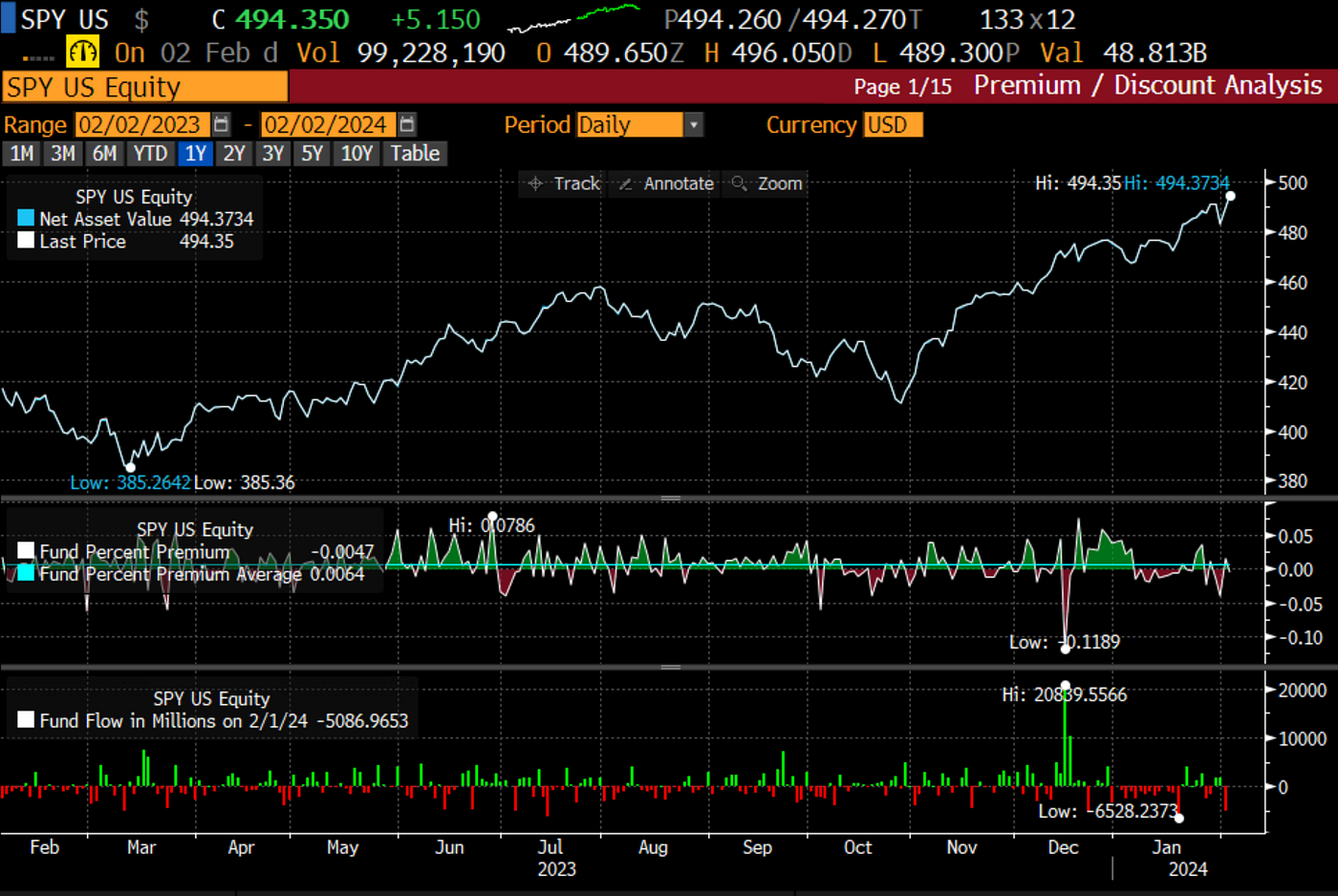
- Premium/Discount Analysis: Compare the ETF’s market price to its indicative NAV (iNAV), which updates intraday. Persistent or unusually large divergences often signal arbitrage potential.
- Order Book and Depth Monitoring: Analysing bid-ask spreads and order book depth helps assess execution feasibility. Wider spreads might suggest liquidity stress—both a risk and an opportunity.
- Tracking Error Patterns: By studying historical tracking error data, traders can identify ETFs prone to dislocations in certain market conditions, such as during rate changes or geopolitical events.
- Cross-Market Relationships: Observing related ETFs or derivatives (such as index futures) can provide clues about mispricing between correlated instruments.
For instance, if an ETF tracking the S&P 500 begins trading at a discount during a sudden sell-off, but the futures market remains stable, a trader might anticipate mean reversion once liquidity normalises.
Execution Strategies for ETF Arbitrage
Once an arbitrage opportunity is identified, execution speed and accuracy become paramount. Traders often employ sophisticated algorithms and multi-venue routing systems to synchronise trades between ETFs and their underlying baskets.
Common strategies include:
- Statistical Arbitrage: Using quantitative models to identify statistically significant deviations from fair value and automate trades that capture these discrepancies.
- Hedged Arbitrage: Taking offsetting positions in the ETF and its underlying assets or futures contracts to isolate pricing inefficiency while minimising directional exposure.
- Cross-Asset Hedging: When underlying assets are illiquid or expensive to trade directly (as in fixed income ETFs), traders may hedge with correlated instruments instead.
An experienced ETF trader will also account for transaction costs, bid-ask spreads, and market impact. These factors can easily erode arbitrage margins, especially in volatile conditions where execution slippage is common.
Managing Risks in ETF Arbitrage
While ETF arbitrage may seem low-risk in theory—since it relies on price convergence—it is far from risk-free in practice. The most significant dangers arise from timing, liquidity, and market structure.
Key risks include:
- Execution Risk: Prices can change rapidly during order placement, leaving traders exposed if one leg of the trade executes while the other lags.
- Liquidity Mismatch: ETFs generally offer better liquidity than some of their underlying holdings, especially in fixed income or emerging markets. This can trap arbitrageurs in positions that are difficult to unwind.
- Tracking Error Volatility: Unexpected divergence between ETF and underlying asset performance can persist longer than anticipated, delaying convergence and magnifying losses.
- Operational and Technological Risk: Complex arbitrage setups require advanced infrastructure. Delays or data feed errors can compromise trade execution.
For these reasons, ETF arbitrage tends to be dominated by institutional participants with the resources, systems, and capital to manage these challenges effectively. Retail traders can still observe and learn from these market patterns, but direct participation often requires sophisticated tools.
Conclusion
ETF arbitrage during market dislocations is not for the faint-hearted. It requires discipline, precision, and the ability to interpret complex, fast-moving market data. Yet for those who understand ETF structure and can navigate temporary inefficiencies, such periods can be among the most rewarding.
In essence, arbitrage is the market’s way of restoring balance—and traders who act as part of that process can profit while enhancing market efficiency. By combining technical knowledge, prudent risk management, and a deep understanding of ETF mechanics, professionals can turn volatility into a strategic edge.

Comments are closed.